Not to win
This isn't about changing someone's mind.
Letter-Writing Resources
Use the guide, examples, letter starter, inserts, and cards in whatever way helps. Nothing here is required, and nothing prints automatically.
Back to the Main PageHave you ever lost touch with or had a falling out with someone who actually mattered to you?
A simple civic challenge
This isn't about politics.
This is how you have a voice in 2026 — not louder, closer.
We don't have to agree in order to treat each other with respect.
Write one respectful letter to someone who matters to you — a rift over politics, sure, but just as often distance, faith, money, or a fight nobody quite recovered from — not to win, but to understand.
Signing up takes about 60 seconds — you can write your letter later.
This isn't about politics. It's about choosing love and honesty over distance — most letters in this project aren't political at all. Division has quietly cost a lot of people something they didn't mean to lose: a friend, a parent, a child, a sibling, a neighbor. Sometimes distance simply creeps in. Other times, the differences are profound, touching morality, dignity, rights, or personal safety. A letter does not erase those stakes, and no one is being asked to minimize them. The request is smaller and harder: even when the disagreement remains, recognize the human being on the other side. It is one way of saying: we may disagree, but you still matter.
This isn't about changing someone's mind.
This isn't a debate or a confrontation.
This means actually trying to hear their side, and not just wait to respond, but actually listen.
One America, rebuilt one conversation at a time.
The Challenge
One conversation.
One person.
One America.
INDIVISIBLE
One letter, to one person, is a personal responsibility. Enough people choosing to carry it turns into a social one — friendships and families holding together instead of drifting apart. Enough communities doing that is what civic responsibility actually looks like in practice, not in a speech.
Start with a relationship where respectful contact feels safe and repair seems possible. It does not have to be your deepest or most intimidating conflict.
Be direct, respectful, honest, and open.
Invite a response and read it with an open mind.
Once you've absorbed the letter, channel it into a new one—to someone you personally care about, not back to the sender.
The method is simple and time-tested: step back from the argument, examine your own part honestly, approach another person with humility, and make a concrete gesture toward repair. Relationships rarely improve until someone chooses to interrupt the cycle.
Unlike an argument, a letter gives you time to choose what you truly mean. The recipient can absorb it privately, without being pressured to defend themselves immediately.
Whether delivered physically or digitally, a carefully written letter shows that this was not an impulsive message. A physical letter can add meaning through the visible effort involved.
People are more able to hear difficult truths when they do not feel attacked, humiliated, or erased. Respect does not require surrendering your beliefs; it creates room for both people to remain human.
Estrangement often continues because both people wait for the other to act first. A letter cannot control the response, but it can end your participation in the silence, hostility, or avoidance—and offer a different way forward.
Success does not require a perfect ending. You cannot control the response. The person may respond warmly, cautiously, much later, or not at all. Success begins with making one honest, responsible attempt without demanding a particular outcome. No one should reopen contact where doing so could cause danger, violate a boundary, or create further harm.
An Oath We Already Share
I pledge allegiance to the Flag of the United States of America, and to the Republic for which it stands, one Nation under God, indivisible, with liberty and justice for all.
Whatever else divides us, most of us have said these same words, the same way, since childhood. That's not nothing. It's a place to start.
I pledge to treat every American with dignity, even when we disagree.
I will seek understanding before judgment.
I will remember that behind every opinion is another human being.
I will be part of the solution—not another voice adding to the division.
Commit to the challenge — even if you're not ready to start today. If you think you can write this letter within the next few weeks or months, please enter your email and make the commitment. We'll help you follow through.
Enter a valid email address.
Your information is collected privately by the founder only to welcome you, measure how far the movement has reached, and respond if you write back. It is never sold or shared with outside organizations. You may occasionally hear directly from the founder about this project or related personal projects. Taking the pledge sends one welcome email with the complete letter-writing package. Questions or deletion requests: [email protected].
This is an independent, student-built project. Every contribution helps cover development and design tools, website and domain costs, outreach, and the ongoing work of maintaining and growing One America, One Letter. Every amount helps.
Contributions are not tax-deductible.
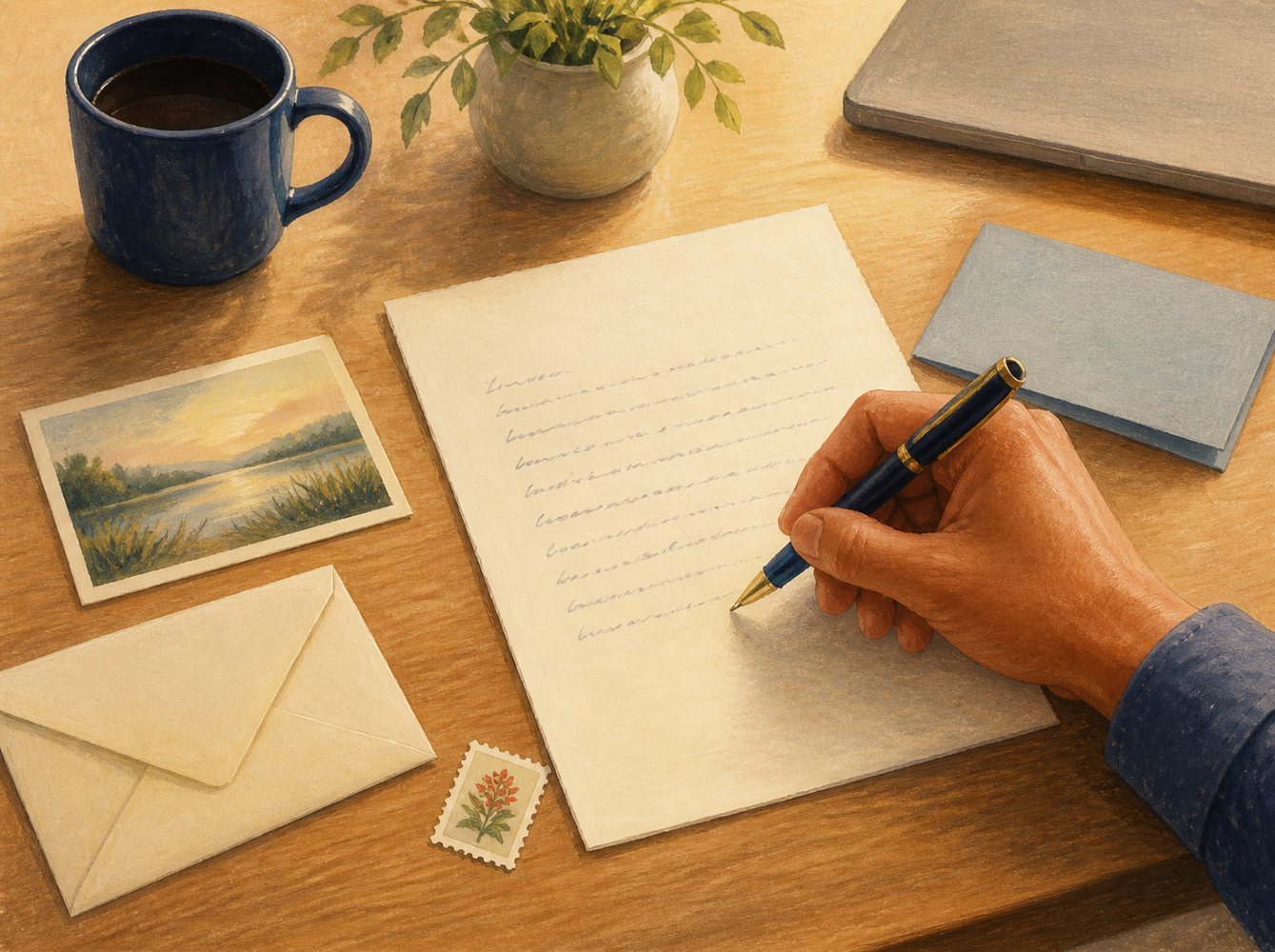
After taking the pledge, choose one person worth reaching. A physical letter is encouraged whenever possible because the time, paper, and delivery make the gesture tangible. If you do not have their current address, live too far away, or digital contact is the only practical way to reach them, a thoughtful email or direct message absolutely counts. Nothing below prints automatically, and you never need to print the entire guide.
Instructions, coaching guidance, and sample letters. Read it digitally; printing all 17 pages is unnecessary.
Open GuideA short checklist and a clean writing sheet. Print this only if it helps you prepare the physical letter.
Open 2-Page KitA complete, letter-size explanation for the recipient: what this is, how to take the pledge, where to find free tools, and how to keep the chain moving.
Open Recipient InsertPrefer something smaller? Open the optional mini cards.
Your personalized pledge-number memento. Keep it in a wallet or show it when inviting a friend.
Your Place in the Movement
One person. One promise. One letter worth keeping.
Join the Count
0
Loading the shared public pledge count…
Next milestone: 100 pledges
You are here — 0% of the way to 300,000,000
This is the shared public count of pledges recorded through this site. Email addresses, names, and states are never displayed here.
Why I Started This
I didn't set out to build a movement. I set out to write one honest letter to a friend, after something hurtful he'd said that I couldn't just let sit anymore. Writing it, and watching what it did for our relationship, felt like more than coincidence to me — I believe I was inspired to take that step, and then inspired again, a week later, to wonder if the same thing could help repair relationships everywhere, not just mine.
I built One America, One Letter myself, in my spare time. I've been out of work for a while dealing with an injury, and this became the thing I decided to pour myself into instead. It's a one-person effort right now — no staff, no organization, just me trying to put something good into the world. I'm not a therapist or a mediator, and this project isn't meant to replace one — if your situation calls for that kind of professional help, please reach for it too.
If you're so inclined, I'd genuinely love to hear what happens after you send your letter. Whatever that looks like for you. Thank you for being part of it — who knows what I'll create next. The sky's the limit on where this goes from here.
— The founder

It took real courage to write, and I mean that. All is forgiven.
— an actual reply, the morning after the letter above was sent
Sample Letters
These aren't a script to copy — they're proof this is possible from wherever you're starting. Only a couple of them touch politics at all — most are about the kinds of rifts every family and friendship runs into: distance, money, faith, grief, growing apart. Different topics, different amounts of polish, on purpose, so nobody reading them feels like they need to be a certain kind of person — or a certain kind of writer — to do this. What they all have in common isn't an argument. It's love.
Dear [Sibling's Name],
It's been almost two years since we've really talked, and I don't want it to be three.
I keep replaying the week after Mom died — how fast everyone had to make decisions about the house, her things, all of it, while we were still in shock. I said some things about the sale that I still think about, and I know at least one of them landed as an accusation about money when it wasn't really about money at all. I was grieving and scared and looking for somewhere to put it, and you were an easy target because you were right there. That wasn't fair to you, and I'm sorry.
I don't think either of us handled that week the way we'd want to if we could do it again. I've had a long time to sit with my part of it, and I'd rather make amends than keep being right about yours.
What I actually miss isn't the argument or even being proven right about the house. It's you. It's calling you when something stupid happens at work because you're the only one who'd find it funny the same way I do. It's not having anyone to call on Mom's birthday who actually remembers what she was like before she got sick.
I'm not asking you to agree with me about what happened, or to pretend it didn't hurt. I just don't want losing Mom to also be the thing that cost me my brother.
If you're willing, I'd like to talk — actually talk, not over text. No agenda beyond that. And if you're not ready, I understand, and I'm not going anywhere either way.
I love you. I miss you.
[Your Name]
Hey [Friend's Name],
I've been meaning to write this for a while and kept putting it off because I didn't know how to say it right. I don't think there's a right way, so I'm just going to say it plain.
When you were going through your divorce, I basically disappeared. I told myself I didn't want to say the wrong thing, but really I think I just didn't know what to do, so I did nothing. That wasn't okay. You needed a friend and I wasn't one, not really, not when it counted.
I'm sorry. Not the kind of sorry you say to end a conversation — the kind where I actually see it and it bothers me.
I don't expect this letter to mend things. I just didn't want to keep pretending it never happened. If you ever want to grab a coffee and actually talk, I'm around. If not, I get it.
Either way, I'm glad you're doing better now.
[Your Name]
Dear [Son's Name],
I've started this letter probably ten times over the last few years and never sent it, because I didn't know how to say this without it sounding like an excuse. I don't want it to be an excuse. I just want to say it.
I was there for a lot of your childhood, but I wasn't really there for a lot of it either. I remember sitting in the stands at your games with my phone out, half-watching, telling myself I'd look up in a minute. I remember being home most nights and still somehow not around — in the next room, working, tired, wound up about something that felt urgent at the time and that I can't even remember now. You didn't need me to be perfect. I think you just needed me to be paying attention, and a lot of the time, I wasn't.
I've spent a long time telling myself that providing was the job — that if the bills were paid and nobody was in danger, I was doing my part. I don't think that's wrong exactly, but I think I used it to let myself off the hook for the rest of it, the part where you actually get to know your kid instead of just keeping him fed and housed.
I'm not writing this to get you to tell me it's fine. I don't think you owe me that, and honestly I'd rather you didn't say it just to make the conversation easier. I'd rather this just be true between us: I wasn't as present as you needed, and that's on me, not on you, and not on anything you did.
What I want now, if you're open to it, is just to actually show up — not with some big gesture, just consistently, in the smaller ways I skipped over before. A call that isn't about anything in particular. Showing up to something without my phone in my hand. I don't expect that to heal everything. I just don't want to keep doing the thing where I mean to and don't.
No pressure to respond right away, or at all if you're not there yet. I just wanted you to have this in writing, from me, instead of continuing to hope you already knew.
Love,
[Your Name]
Dear [Friend's Name],
I've written and deleted this text about a dozen times, so I'm doing it as a letter instead, where I can actually say the whole thing instead of a half version.
It's been about four years since I lent you the money for the car repair, and somewhere in year two I noticed I'd stopped expecting it back, and somewhere in year three I noticed I'd also mostly stopped talking to you, and I don't think those two things are unrelated even though neither of us ever said so out loud.
I want to be honest: for a while it did bother me. Not really the amount — it wasn't enough money to change my life either way — but the quiet of it. No plan, no "hey, I haven't forgotten," just nothing, and then it got awkward to bring up, and then it got easier to just not text you than to bring up something that felt like it might turn into a fight.
I don't think you're a bad person for how this went, and I don't think I am either for how weird I got about it. I think we both just let an uncomfortable conversation turn into a long silence because neither of us wanted to be the one to reach out first.
So I'm saying it now: I don't need the money back for this to be okay. I mean that. What I actually miss is you — the guy who'd show up with no notice with terrible coffee because you knew I was in the middle of finals, who I could call at midnight when things were falling apart. That's what this cost us, and it's worth more to me than what I lent you.
If you want to pay it back sometime, fine, no hard feelings either way. But that was never really what I wanted this letter to be about. I just didn't want the money to be the reason we stopped being friends without either of us ever deciding to.
Take care of yourself,
[Your Name]
Dear [Mother-in-law's Name],
This isn't an easy letter to write, and I've hesitated for a long time because I didn't want it to come across as an accusation. It isn't one. I don't think you've ever set out to make me feel unwelcome. But I want to be honest with you about something I've been carrying for a while, because I'd rather say it plainly than keep quietly holding it.
At family gatherings, I often feel like I'm on the outside of something — like there's a version of the conversation, the jokes, the history, that I'm not quite inside of, even after all these years. I don't think that's anyone doing something wrong exactly. I think it's just what happens when you marry into a family that already has its whole shared life built before you show up. But it's been lonelier than I think anyone realizes, including me, for a long time.
[Spouse's name] loves you and loves this family, and I never want to put [him/her] in the middle of this or make family time feel tense. That's the last thing I want. I just think if I keep pretending I feel completely at home when I don't, it'll stay quietly true forever instead of maybe actually changing.
I don't have a specific ask, really. I think I just wanted you to know how it's felt for me, in case there was ever an opening — a call that's just us, or being included a little more in the ordinary stuff, not just the big holidays where everyone's already used to their roles. I'd like to actually feel like part of this family, not just someone who's allowed to be at it.
I know this might not be easy to read, and I promise it's not meant as a complaint about you specifically. I just care about this family enough to want to actually belong to it, not just attend it.
With respect,
[Your Name]
Dear [Friend's Name],
I've been thinking about your post since Tuesday, the one about how nobody should be allowed to own a gun like the one used at that school. I didn't respond right away, and I'm glad I didn't, because my first reaction wasn't really an argument — it was just defensiveness, and that's not what this deserves.
I need to say this first, before anything else: I am so sorry for those families. I read the names of those kids the same night you posted, and I sat with my own kids asleep down the hall and couldn't stop thinking about it. Nothing I say below is meant to talk past that grief, or to suggest your fear for other people's children is somehow less legitimate than my reasons for owning what I own. It isn't.
But I do own guns, and I raised my kids around them, and I want you to understand why, because I don't think you actually know — I think you know the bumper-sticker version of someone like me, not the real one.
My dad taught me to shoot on his dad's old .22 when I was nine, out past the property line where nobody could hear but the crows. It wasn't about danger or power. It was one of maybe three things my dad and I did together that he was actually good at teaching and I was actually good at learning, and in a house where we didn't have a lot else in common, that mattered more than I think I can fully explain to you. I've since taught my own son the same way, on the same kind of gun, with the same rules my dad drilled into me before I was ever allowed to touch one: it's loaded until you've checked it yourself, it never points at anything you're not willing to destroy, your finger stays off the trigger until you've decided to fire. I take that seriously. I've never once treated it casually, and I don't know anyone in my life who does.
I also keep a handgun in the house, and that one isn't about my dad or hunting. It's because I live twelve minutes from the nearest sheriff's response on a good night, and I have a wife and two kids I am responsible for getting to safety if something happens in this house that I can't talk or run my way out of. I hope to God I never touch it for that reason. But I'm not willing to bet my family's safety on hoping.
I know the statistics get thrown around from both directions until they stop meaning anything to either side, so I won't pretend I can out-argue you with numbers. What I can tell you is that for me, this was never about a symbol, a party, or wanting to feel like a tough guy. It's about a relationship with my father I didn't get in many other ways, and a plan for my family's safety that I've thought about more soberly than almost anything else in my life.
I'll be honest that I don't think every gun law is an attack on me personally, and I don't think every person who wants stricter rules is trying to disarm good people out of spite. I actually agree with you on more of the specifics than you might expect — I think a lot about training requirements, about how a gun ends up in the wrong hands, about whether the guy who did that shooting should have ever had access to what he had. Those aren't unreasonable questions. I just don't think the answer is that the right to own one at all should depend on convincing enough strangers I deserve it.
I don't need you to end up agreeing with me on any of that. I'd just like you to know that when you see someone post something defending gun ownership, it might not be the caricature you're picturing — for at least one person you actually know, it's a dad, a husband, and someone who thinks about this as carefully and as seriously as you do.
Can I ask you something in return? What would actually make you feel safer — not as a slogan, but specifically? I'd genuinely like to know, because I think we want the same thing here even if we'd get there differently.
Whatever you land on, this doesn't change how I feel about you. You've been a good friend to me for a long time, long before either of us ever said a word about any of this, and that's not going anywhere over a Facebook post.
With respect,
[Your Name]
Hey [Friend's Name],
I was thinking about you the other day for no real reason — I think a song came on that we used to play way too loud in your old car — and I realized it's been something like five years since we've actually talked, not just liked something on each other's pages.
I keep trying to remember what the fight was, and there wasn't one. That's almost the strange part. You got married, I moved for work, we both had kids around the same time, and somewhere in the shuffle of all of it, checking in stopped being a habit and became a thing you mean to do and don't. I don't think that's really anyone's fault. I think it's just what happens if nobody catches it.
I still think about the year we lived three blocks apart and you'd show up at my door with no notice, or the trip we took that neither of us could really afford, or you sitting with me the week my grandfather died even though you barely knew him, just because you knew I shouldn't be alone. I don't have a lot of people who did that for me. I've never really replaced that.
I'm not writing this because anything's wrong, or because I need something. I just didn't want another year to go by without saying that you mattered to me then and you still do now, even with all the silence in between. If you're ever up for reconnecting — even just a call, no big production — I'd really like that.
Either way, I'm glad you're out there living a good life. I hope it's everything you wanted.
[Your Name]
Dear [Friend's Name],
I've been thinking about your Facebook post about Dr. Fauci and why it bothered me more than I expected. After sitting with it for a while, I realized it wasn't because I needed you to agree with me. It was because I care about you, I value our friendship, and I wanted you to understand why I see things differently. I don't normally write letters like this, but I feel it's important to handle this differently than I began earlier tonight.
I deeply appreciate the gas money you've given me. It's helped me get to meetings when I honestly couldn't have afforded it, and I don't take that generosity for granted. But what I value most isn't the gas money. It's your friendship. I look up to the example you set, the positivity you bring into the rooms, the way you're willing to call me out when I'm judging my family or someone else, and the way you aren't afraid to tell a friend a hard truth, even when it's awkward or uncomfortable. In a lot of ways, I guess this letter is my attempt to be that kind of friend back to you.
It didn't feel right to respond on Facebook. I wasn't interested in adding to the division or the drama, and I didn't want to call you out in front of everyone. I respect you too much for that. This felt like something that belonged in a private conversation between friends, but I needed time to gather my real thoughts and not be reactive like the alcoholic inside me was trying very hard to be.
Part of what made that post difficult for me had less to do with politics than with something much more personal. Because AA has become such an important part of both of our lives, I couldn't help viewing it through that lens.
One of the greatest gifts AA has given me is the reminder to be careful about judgment, to look at my own motives before criticizing someone else, and to remember that every person—even the ones I disagree with—is a flawed human being deserving of compassion. I'm far from perfect at living those principles myself, but they're values I keep trying to grow toward.
When I read your post, I found myself struggling because it didn't feel consistent with that spirit. It seemed to me that Dr. Fauci had been reduced to a symbol or a villain instead of being viewed as a human being who was trying to navigate an unprecedented crisis, however imperfectly. Whether we ultimately agree with his decisions isn't really the point. What stayed with me was the feeling that the conversation wasn't about unity, love, and compassion, but instead was filled with certainty and condemnation.
I know a lot of people believe Dr. Fauci lied to the American people during the pandemic. I understand why they feel that way. COVID was frightening, information changed constantly, and the government's messaging was often confusing. Trust was damaged, and once that happens it's hard to rebuild.
But after reading reports, testimony, and investigations from a variety of perspectives, I've come to a different conclusion. I don't believe the evidence shows that Dr. Fauci intentionally deceived the American people.
One of the biggest examples people point to is masks. Early in 2020, Dr. Fauci and other public health officials said the general public didn't need them. Later they strongly recommended them. On the surface, that looks like a contradiction.
But context matters.
At the beginning of the pandemic, scientists knew much less about asymptomatic spread, and hospitals were facing severe shortages of protective equipment. As researchers learned more about how the virus spread, and as mask supplies improved, the recommendations changed.
To me, changing recommendations when new evidence emerges isn't proof of dishonesty. It's how science is supposed to work. If scientists refused to change their conclusions after learning something new, that would be the opposite of science. Could those changes have been communicated better? Absolutely. I think that's a fair criticism. But changing your guidance because the evidence changes is very different from intentionally lying.
The same is true when it comes to the origins of COVID. From everything I've read, Dr. Fauci consistently said the evidence at the time leaned toward a natural spillover from animals while acknowledging that a laboratory accident hadn't been ruled out. Even today, different US government agencies have reached different conclusions with different levels of confidence. That tells me this is still a complicated question—not one with a simple, universally accepted answer.
I've also heard the claim that Dr. Fauci "funded the creation of COVID." It's true that U.S. research funding supported coronavirus research through grants involving international collaborators. Whether that research should have been funded is a legitimate debate. But I haven't found evidence showing that Dr. Fauci knowingly funded the creation of SARS-CoV-2 or intentionally misled the public about it.
What I've spent even more time thinking about, though, is why Dr. Fauci became the face of so much public anger.
He wasn't the President. He wasn't a governor. He couldn't order nationwide lockdowns, close schools, pass spending bills, or set state policies. He was an advisor—a physician and scientist whose job was to offer recommendations. The actual decisions were made by elected officials at every level of government.
That doesn't mean his advice shouldn't be questioned. It should. Every public official should be accountable for what they say and do.
But sometimes I wonder whether focusing so much blame on one scientist has made it easier to avoid asking harder questions about everyone else who had the authority to make decisions. The pandemic wasn't shaped by one person. It involved thousands of decisions made by presidents, governors, legislators, health agencies, hospitals, businesses, and ordinary people trying to navigate an impossible situation.
History is usually more complicated than finding one person to blame.
I'm not saying Dr. Fauci handled everything perfectly. I don't believe that. He made mistakes. Some of his messaging could have been clearer. There are plenty of pandemic policies that reasonable people can criticize and debate. I have my own questions about some of them.
But making mistakes during an unprecedented crisis isn't the same as intentionally deceiving the public.
What ultimately persuaded me is that after years of investigations, congressional hearings, lawsuits, media scrutiny, and political attacks, I still haven't seen evidence that establishes Dr. Fauci deliberately lied to the American people in the sweeping way that's so often claimed. There are arguments about policy, judgment, and communication. Those are worth having. But those arguments aren't the same as proving intentional dishonesty.
One of the qualities I've always appreciated about you is that you don't seem content to simply accept what you're told. You seem to want to think things through for yourself. I genuinely admire that. I think skepticism is healthy. I just hope we apply that same skepticism to every source, even the ones that tell us what we already want to hear. I try to hold myself to that same standard because I know how easy it is for all of us to fall into confirmation bias.
I'm not asking you to trust Dr. Fauci because he was a government official, because the media defended him, or because he served under seven presidents from both political parties. Those facts don't prove someone is right.
I'm only asking that we judge people by the strength of the evidence rather than by how often a claim is repeated or how useful it is politically.
If, after looking at the same evidence, you still come to a different conclusion, I can respect that. My goal isn't to change your mind nearly as much as it's to explain mine.
Our friendship means far more to me than any disagreement about politics or the pandemic. I hope we can keep talking the way friends should, with honesty, humility, curiosity, and respect. Even when we disagree, I'd rather understand each other than try to defeat each other.
With love and consideration,
[Your Name]
Dear [Parent's Name],
I've wanted to write this for a long time and kept putting it off, partly because I know it's a tender subject for you, and partly because I wasn't sure I could say it without it turning into an argument about who's right. I don't want it to be that. I just want you to actually understand where I am, instead of guessing at it or worrying in silence.
I know it was hard for you when I stopped going to services. I know part of you took it as a rejection — of the way you raised me, maybe even of you. I want to say clearly that it wasn't that. The faith I grew up in gave me a lot of good things: a sense of community, a language for gratitude, people who showed up for our family when we needed them. I haven't forgotten any of that, and I'm not pretending it didn't shape me, because it did.
What changed is more specific than "I don't believe anymore," even though I know that's how it probably looked from outside. It's more that over time, some of what I was taught to believe stopped fitting with what I actually think is true, and I got to a point where I couldn't keep saying I believed something I didn't, just to keep things comfortable at home.
I know that's not the outcome you hoped for, and I'm not asking you to be happy about it. I'm only asking that you not read it as me rejecting you, or rejecting the values you actually gave me — honesty, showing up for people, trying to live a decent life. Those didn't leave when the specific beliefs did. If anything, being honest with you about this instead of quietly going through the motions felt like the most consistent thing I could do with what you taught me.
I still want you at my table, and I still want to be at yours. I don't need us to agree about this for that to be true. I just didn't want there to be a wall of things we're both too careful to say out loud between us anymore.
I love you, and none of this changes that.
[Your Name]
Letter Starter
If you can talk, you can write. Say it the way you'd say it out loud — that's enough of a first draft.
Dear ________,
I'm writing because I value our relationship more than our disagreement. I don't expect either of us to abandon what we believe, but I would like us to understand each other better.
Here is what I want you to understand about my perspective…
And here is what I genuinely want to understand about yours…
Sincerely,
________
Add this at the end of your letter so the recipient understands why you reached out and knows how to continue the chain. For a digital letter, copy and paste it directly. For a physical letter, write it in or include the printable insert.
P.S. I wrote this as part of One America, One Letter—a movement asking each person to reach out honestly to someone who matters, even when disagreement or distance remains. If this letter means something to you, please visit OneAmericaOneLetter.org, take the pledge so your participation is counted, and pass it forward by writing one letter of your own.
Include this one-sided, letter-size page with your letter. It explains the project clearly and guides the recipient back to the website.
You received something real.
Someone chose time, paper, and honest words—and chose to send them to you. This letter is part of One America, One Letter: an invitation to choose dignity and human connection, even when disagreement remains.
Your next step: Visit OneAmericaOneLetter.org, take the pledge with your email so your participation is counted, and use the free letter tools and examples.
Then send one honest letter or note of your own—physically when possible, or privately by email or direct message when that is the practical way to reach them. Include this guide or the copy-and-paste movement note so the next person can do the same. One letter becomes two. Two become four. Keep the chain moving.
Printing is optional. Use the separate Print Center above to choose a two-page letter kit or one-page card sheet. This expanded material is designed primarily for reading on screen.
Dear ________,
I'm writing because I value our relationship more than our disagreement. I don't expect either of us to abandon what we believe, but I would like us to understand each other better.
Here is what I want you to understand about my perspective…
And here is what I genuinely want to understand about yours…
Sincerely,
________
A Few Tips, If You Want Them
Take Part
Use #OneAmericaOneLetter when you share your experience.
Not ready to start today? That's okay. Commit now, and we'll be here when you are. Whether it's next week or next month, knowing you've made this commitment makes all the difference.
Don't have someone specific in mind right now? That's alright too — maybe you've already made peace with the people who mattered, or the moment just hasn't come yet. If this message still means something to you, one of the most meaningful ways to help is passing it along. Share it with a friend or family member who might need to see it today. Helping the right person find this is a real contribution, even if you never write a letter of your own.
Download Share Graphic